DentalCostBook logo

Dental Implants

Dental Implants Cost Calculator

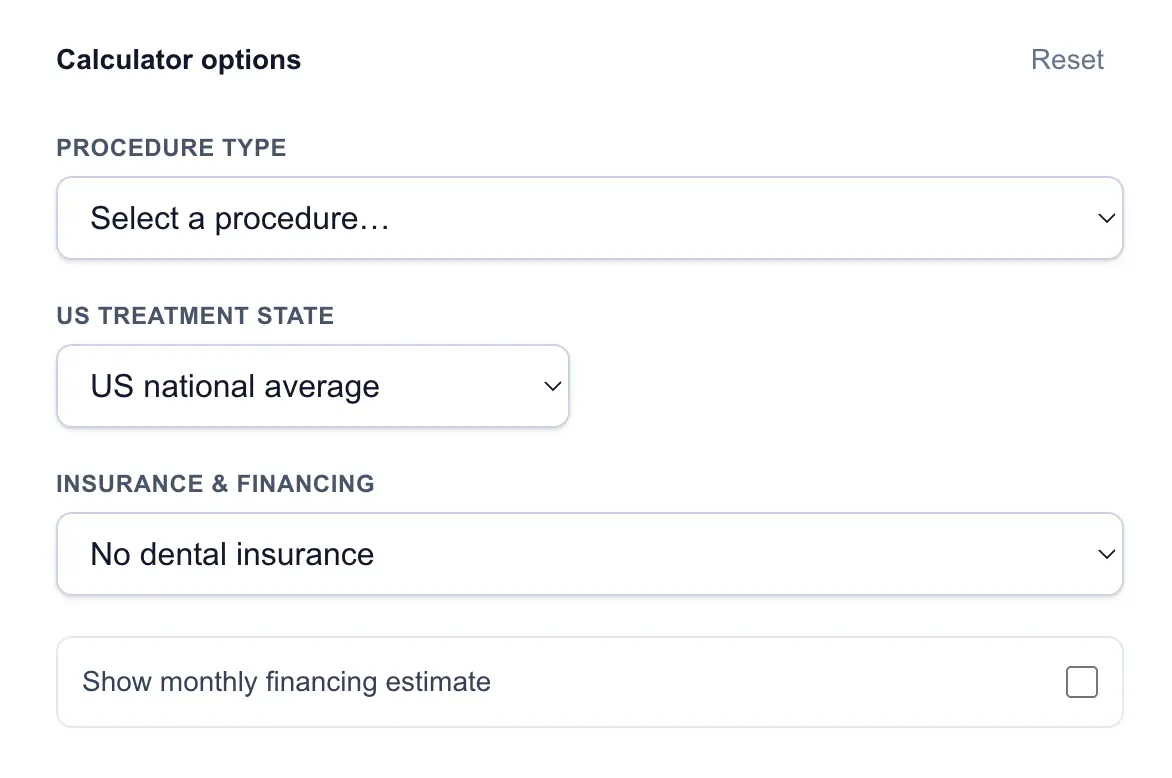
Calculator options

Select a procedure to begin

Select a procedure to begin. Your estimate will appear instantly and update as you adjust the other options.

Get an all-in estimate for a single tooth, All-on-4, All-on-6, implant denture, or full-mouth restoration — with an itemized breakdown of the implant, abutment, crown, imaging, sedation, and add-ons your case may need. Enter your state and your insurance to see what you're likely to pay out of pocket. Estimates use public US dental-cost references published from 2022–2026 and were last reviewed September 2, 2026. See our sources and calculation methodology.

A more complete estimate

How This Calculator Works, And Why It's Built Differently

Most dental implant calculators online are marketing tools dressed up as calculators. They quote you the cheapest possible number — usually just the titanium post — so the total looks manageable and you're more likely to hand over your contact information to the practice behind the tool. Then you show up for the consultation and the real quote is two or three times what the calculator promised.

This calculator is built differently. It exists to tell you what a real implant will actually cost — before you walk into a dentist's office, without asking for anything in return. Here's exactly how it does that, and why each design decision matters for the number on your screen.

1

All-in pricing, from the first estimate

A complete dental implant isn't one thing. It's three components that get billed as separate line items on your final invoice:

The implant post

$1,200–$2,400

The titanium screw placed into your jawbone.

The abutment

$400–$800

The connector piece joining the post to the crown.

The crown

$1,400–$2,800

The visible tooth that sits on top.

Calculators that quote only the post give you a number that feels great until you sit down with a dentist. This calculator includes the implant, abutment and crown by default. Imaging and other additional services are added when selected.

2

State-level pricing, because national averages are meaningless

A single dental implant averages around $3,780 in Alabama (0.84 multiplier) and $5,715 in California (1.27 multiplier) in California — a nearly $2,000 spread for the exact same procedure. National-average calculators split the difference and get both states wrong.

This calculator applies a state-specific price index to every estimate, derived from CareCredit’s 2024 state-by-state single-tooth implant averages. Change your state and the whole estimate re-prices itself.

3

Materials and brand tiers priced individually

Crown material and implant brand aren't cosmetic choices — they meaningfully change the price. Zirconia crowns cost roughly 15–20% more than porcelain-fused-to-metal. Premium implant systems from Straumann or Nobel Biocare cost 20–30% more than well-established value-tier brands like Zimmer or BioHorizons.

Most calculators pick one combination as the default and price everything the same. This calculator applies its material adjustment only to the crown component. Porcelain-fused-to-metal uses a 0.85 multiplier, zirconia is the 1.00 reference option, and E-max uses a 1.15 multiplier. The brand adjustment applies only to implant components: value tier uses 0.90, mid-range uses 1.00, and premium uses 1.15.

4

Insurance math done the way insurers actually do it

Multiplying a treatment total by your coverage percentage is not how dental insurance works. Real PPO plans apply four rules, in this order:

  1. 1Subtract your deductible from the treatment cost
  2. 2Multiply the remainder by your coverage percentage
  3. 3Cap the result at your remaining annual maximum
  4. 4Whatever's left over is your out-of-pocket cost

Worked example

The annual maximum is what breaks naive calculators. Take a $5,000 single implant on a plan with 50% coverage, a $50 deductible, and a $1,500 annual maximum. Naive math says insurance covers $2,500. Real math: ($5,000 − $50) × 50% = $2,475, capped at $1,500. Insurance pays $1,500. You owe $3,500. The naive estimate is off by $1,000 on a single implant — and the gap widens on multi-implant cases where the annual cap runs out even faster.

This calculator does the real math. You enter your coverage percentage, deductible, and remaining annual maximum, and the estimate applies them in the correct order.

5

Nothing between you and your estimate

No account. No email. No phone number. No health history. No "we'll have a treatment coordinator call you." The calculator runs entirely in your browser — your inputs never leave your device, so there's nothing on our end to sell to a third party, because there's nothing on our end at all.

When you want to keep the estimate, three options are built in: print it directly, save it as a PDF through your browser's print dialog, or copy a plain-text summary to paste into your notes or send to a family member. That's the entire export flow.

Step-by-step guide

How to Use the Dental Implants Cost Calculator

The calculator updates your estimated dental implant cost immediately as you change your selections. Follow the steps below to build an estimate based on your procedure, location, materials, insurance, and any additional treatment you may need.

Step 1

Select your procedure

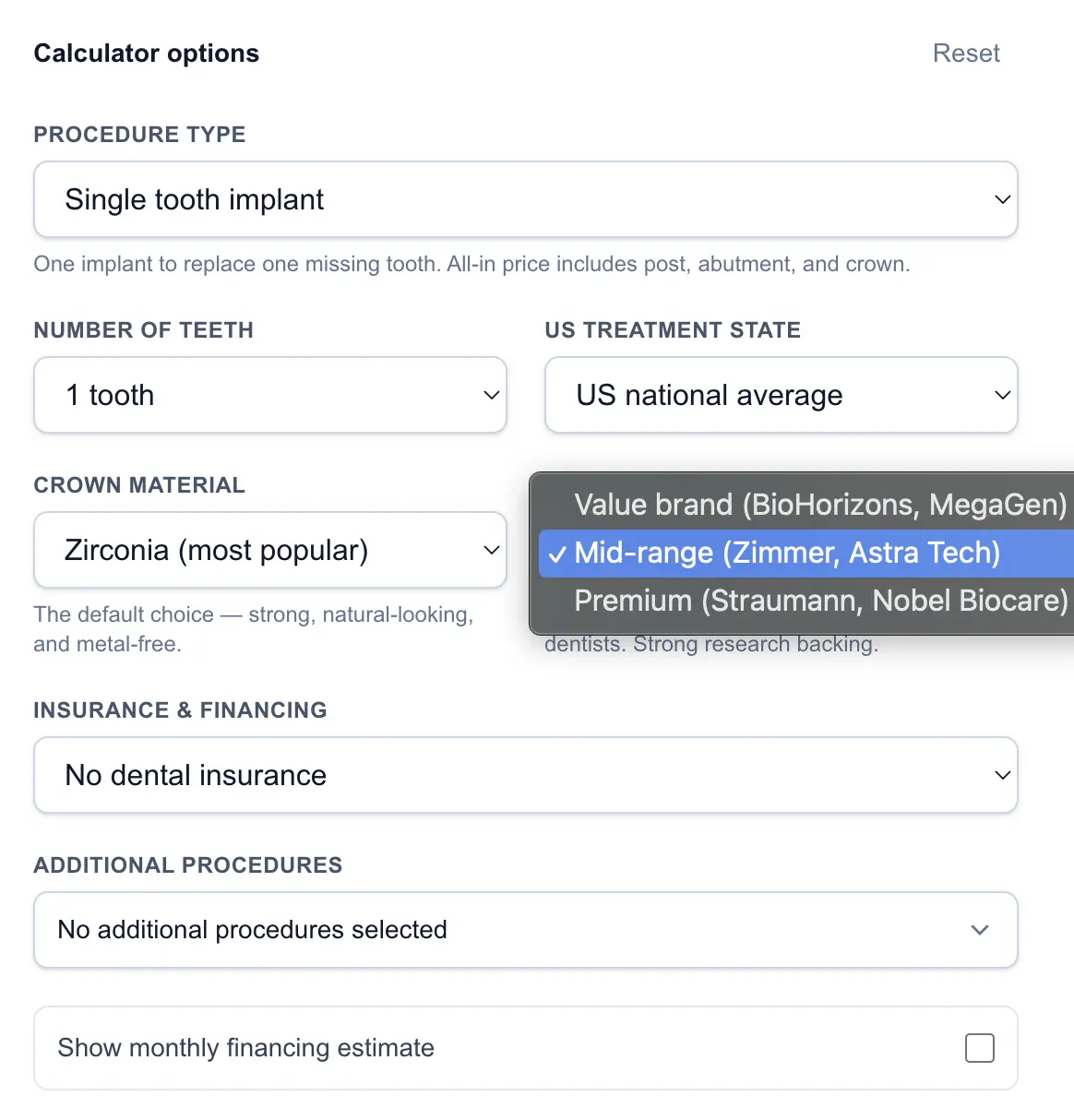
Open the Procedure Type menu and choose the treatment you want to estimate. The available procedures include a single-tooth implant, an implant-supported bridge, a snap-on implant denture, All-on-4, All-on-6, and full-mouth restoration.

The calculator options automatically change based on the procedure you select.
Procedure Type menu showing the available dental implant procedures
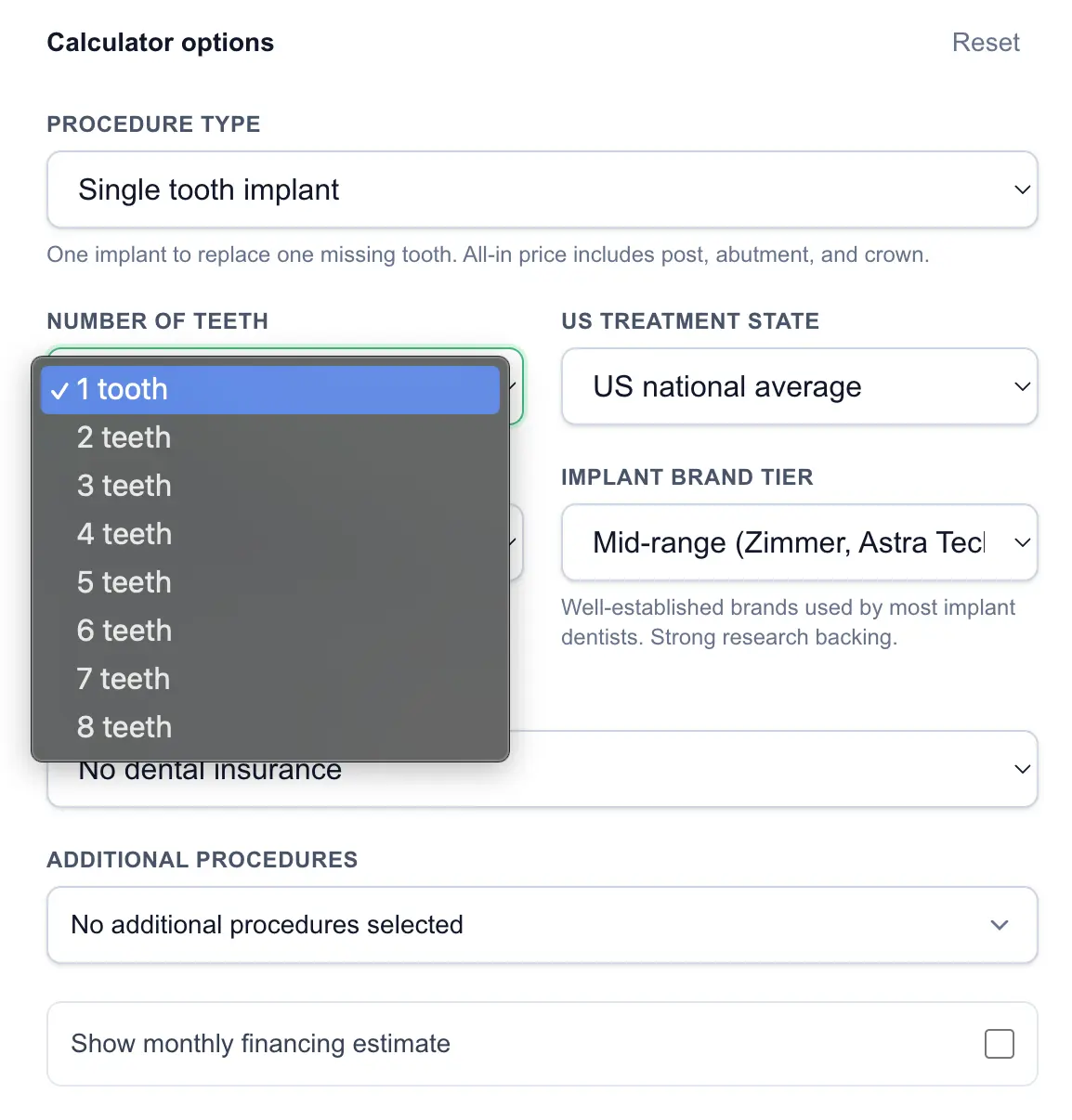
Number of teeth menu for a single-tooth implant estimate

Step 2

Choose the number of teeth or arches

For individual implants, select how many teeth need to be replaced. You can estimate between one and eight teeth.

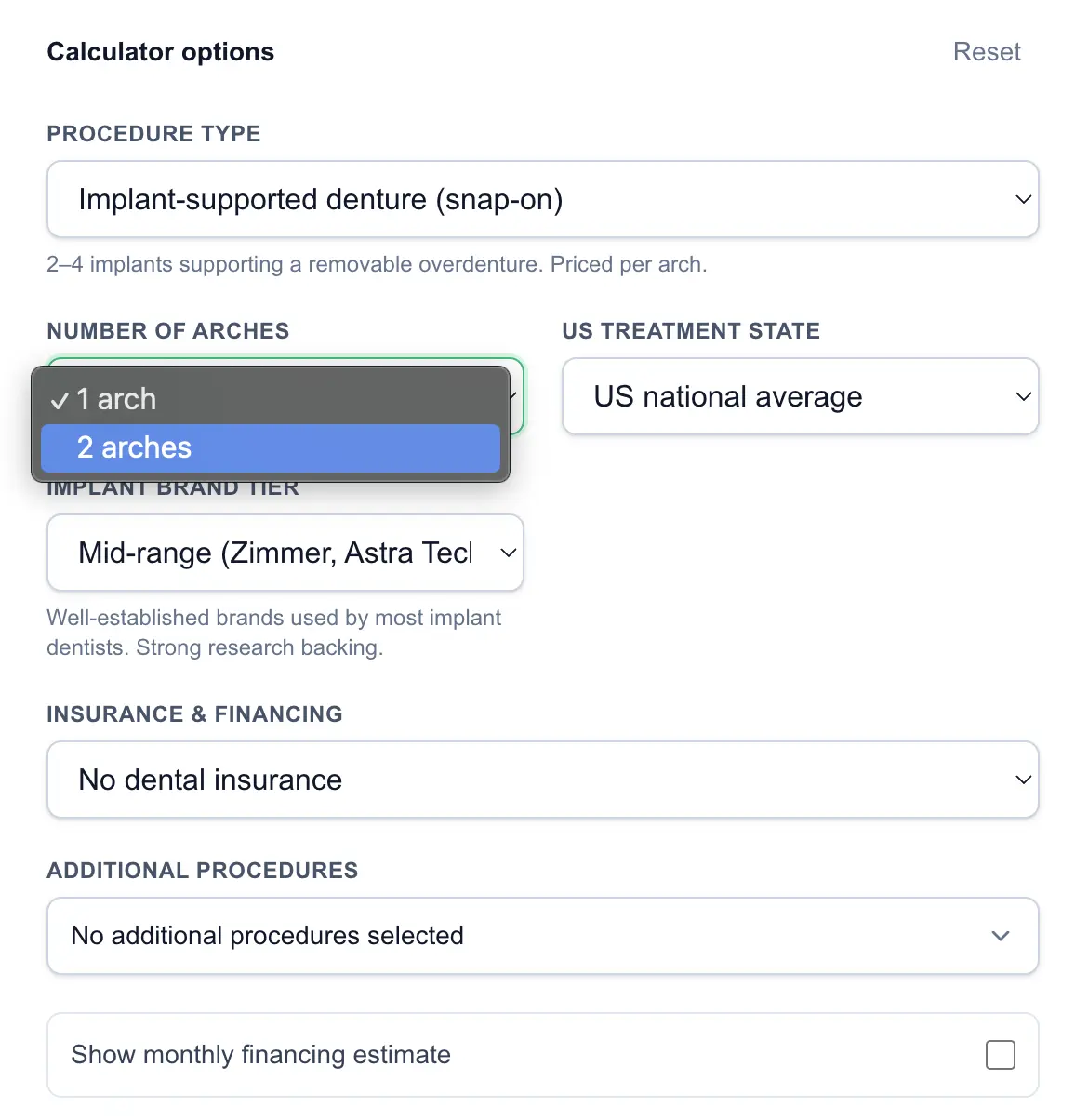
For treatments priced by arch, such as a snap-on implant denture, All-on-4, or All-on-6, choose one arch or two arches. One arch means either the upper or lower jaw. Two arches means both jaws.

Number of arches menu showing one arch and two arches

Step 3

Select your treatment state

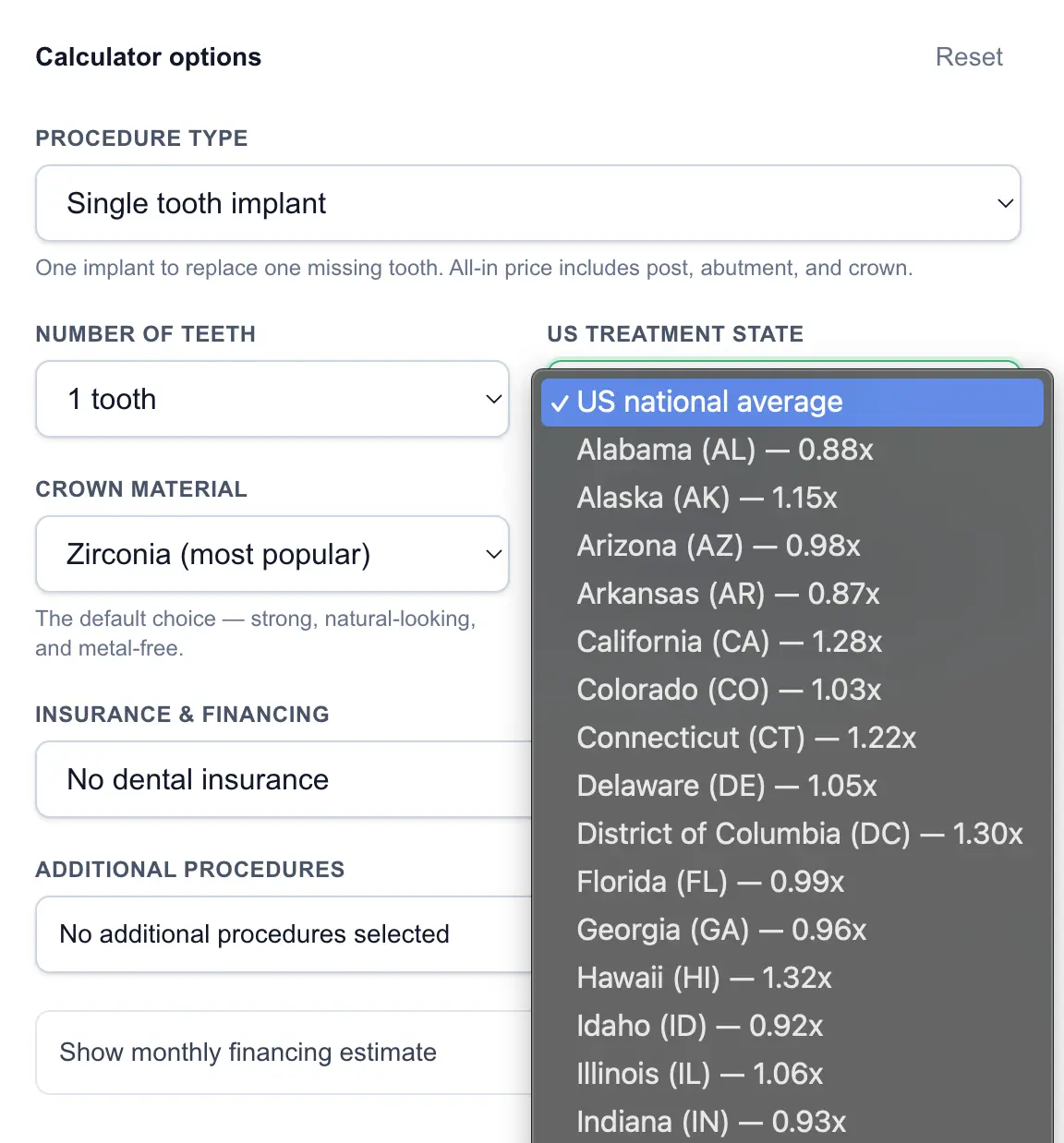
Choose the US state where you expect to receive treatment. Dental implant prices vary considerably by location, so the calculator applies a state-specific cost adjustment to the complete estimate.

If you have not selected a dentist or location yet, leave this option set to US national average.

US Treatment State menu showing state-specific price adjustments
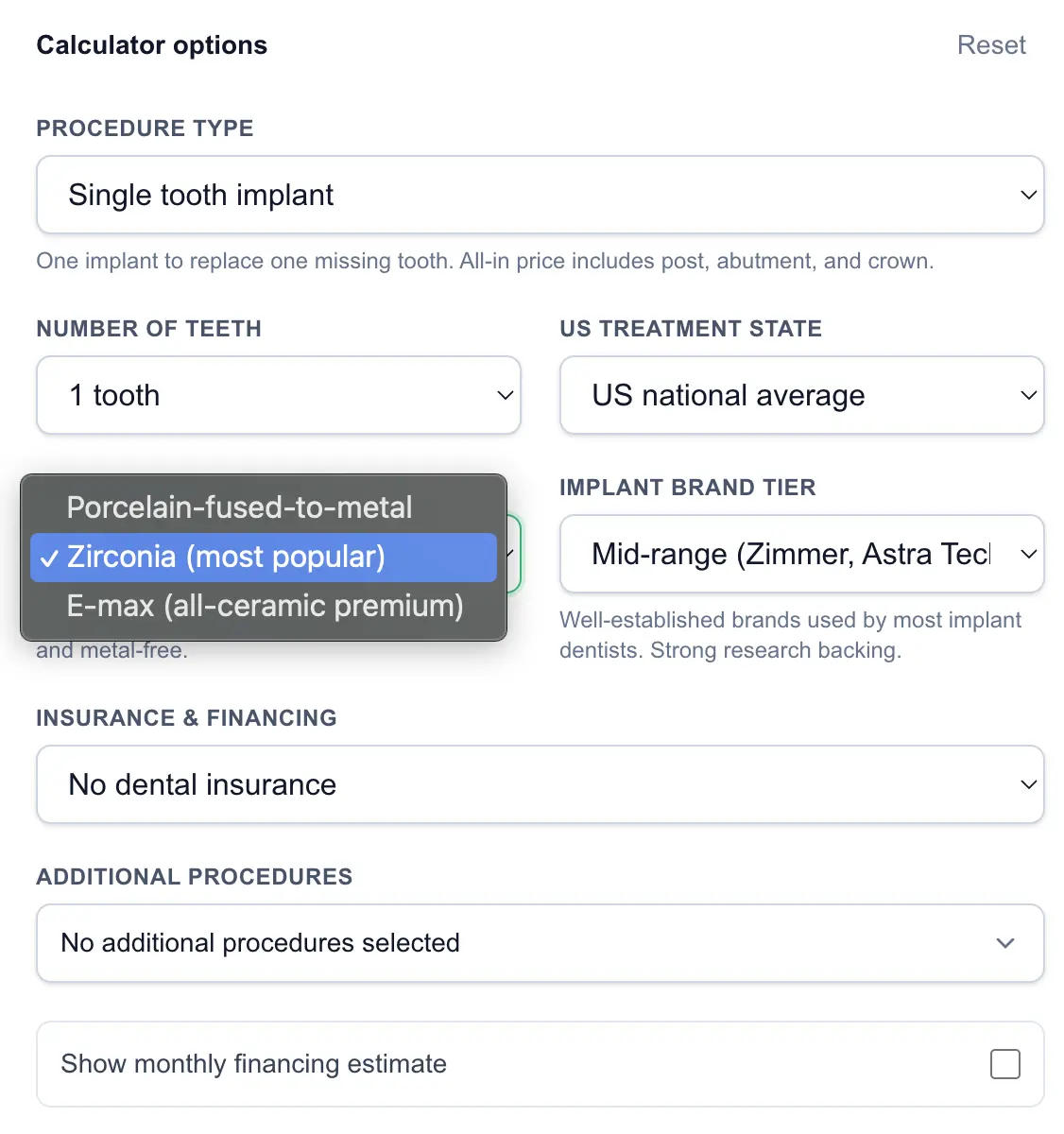
Crown Material menu showing porcelain-fused-to-metal, zirconia, and E-max

Step 4

Choose your crown material

Select the crown material you expect to use. The available choices may include porcelain-fused-to-metal, zirconia, and premium E-max all-ceramic crowns.

Zirconia is selected by default because it is a popular, durable, natural-looking, and metal-free option. Different materials change the estimated crown cost.

Step 5

Select an implant brand tier

Choose between value, mid-range, and premium implant brand tiers. The brand tier adjusts the estimated cost of the implant components.

  • Value: Established, lower-cost implant systems.
  • Mid-range: Well-established brands commonly used by implant dentists.
  • Premium: Higher-cost systems from brands such as Straumann and Nobel Biocare.
Implant Brand Tier menu showing value, mid-range, and premium choices
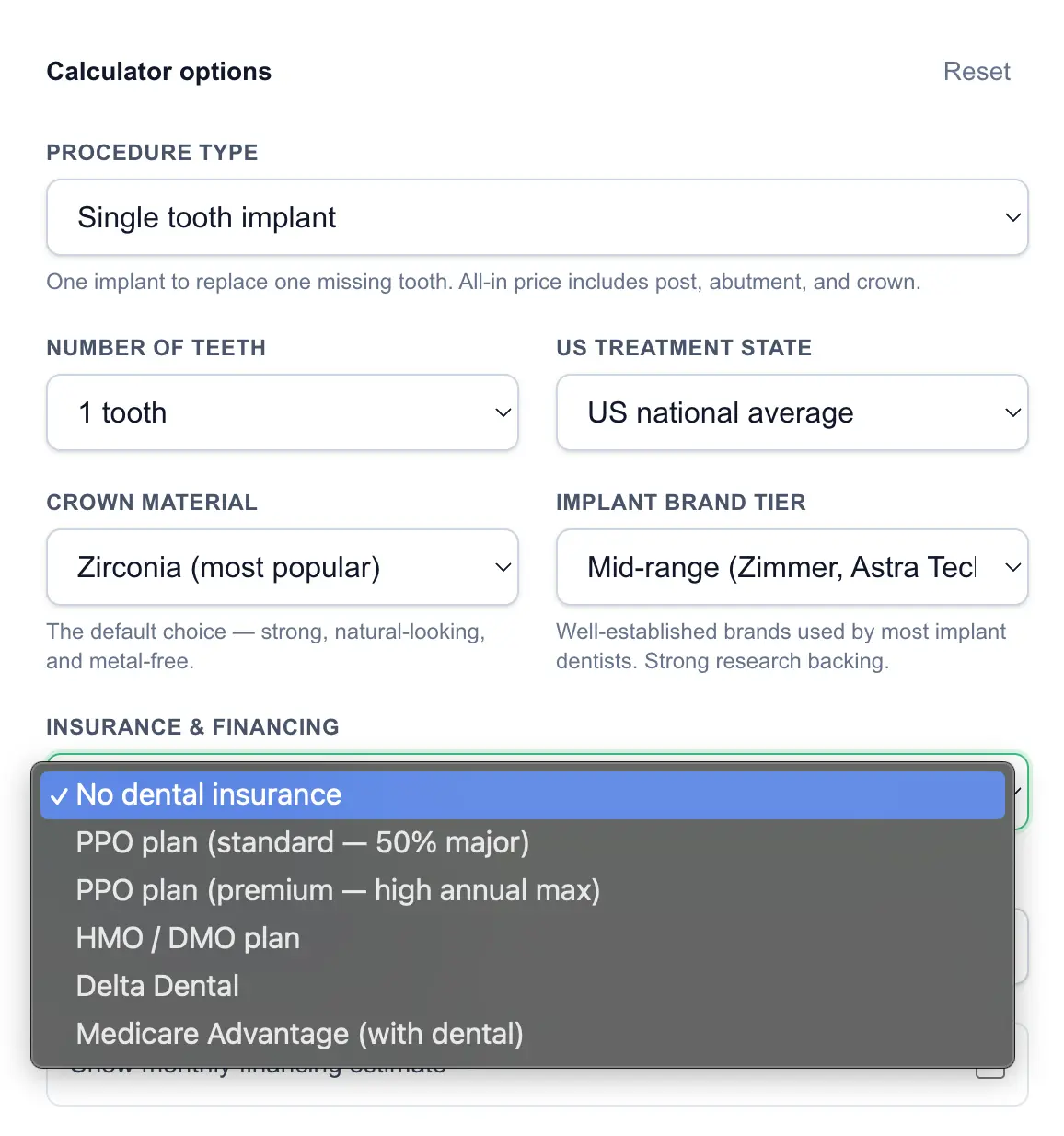
Insurance and Financing menu showing dental insurance choices

Step 6

Enter your insurance information

Select the insurance option that most closely matches your coverage. If you do not have dental insurance, leave it set to No dental insurance.

When insurance details are available, the calculator considers the coverage percentage, deductible, and remaining annual maximum to estimate the insurer's contribution and your likely out-of-pocket cost.

Step 7

Add any additional procedures

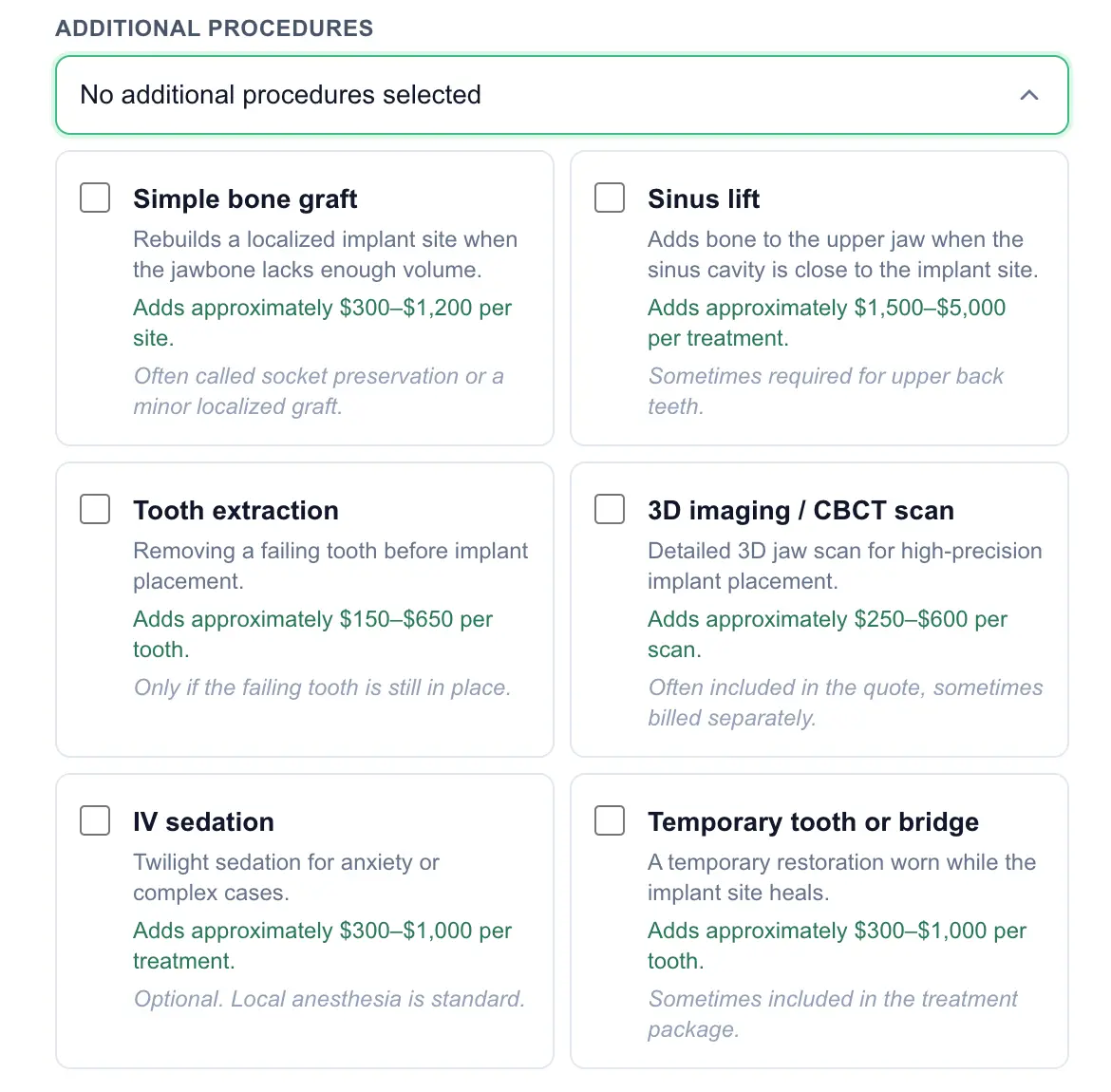
Open Additional Procedures and select only the services you expect your case to require. These can include a simple bone graft, sinus lift, tooth extraction, CBCT scan, IV sedation, or a temporary tooth or bridge.

Each selected service is added to the estimate. If you are unsure, leave the options unselected until a dentist confirms that they are needed.

Additional Procedures panel showing optional dental implant services
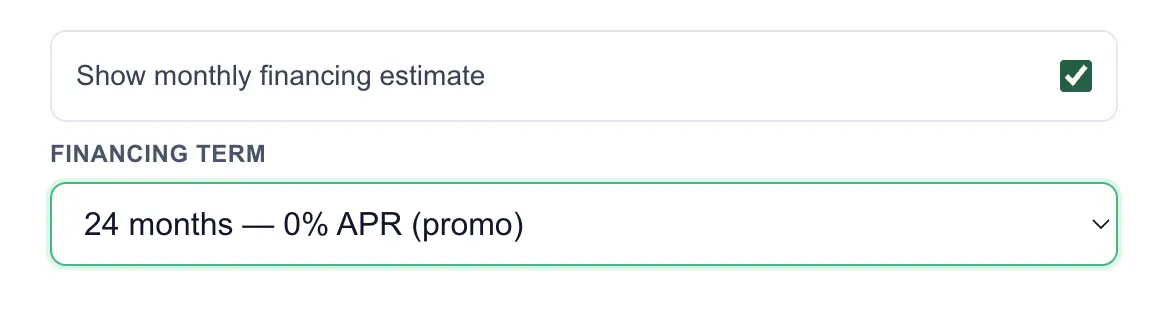
Monthly financing estimate option and financing term menu

Step 8

Show an optional monthly financing estimate

Check Show monthly financing estimate if you want to see an example monthly payment. Then choose the financing term and available APR option.

This is an illustrative payment estimate. Actual interest rates, promotional terms, approval, and monthly payments depend on the lender and your credit profile.

Step 9

Review your real-time estimate

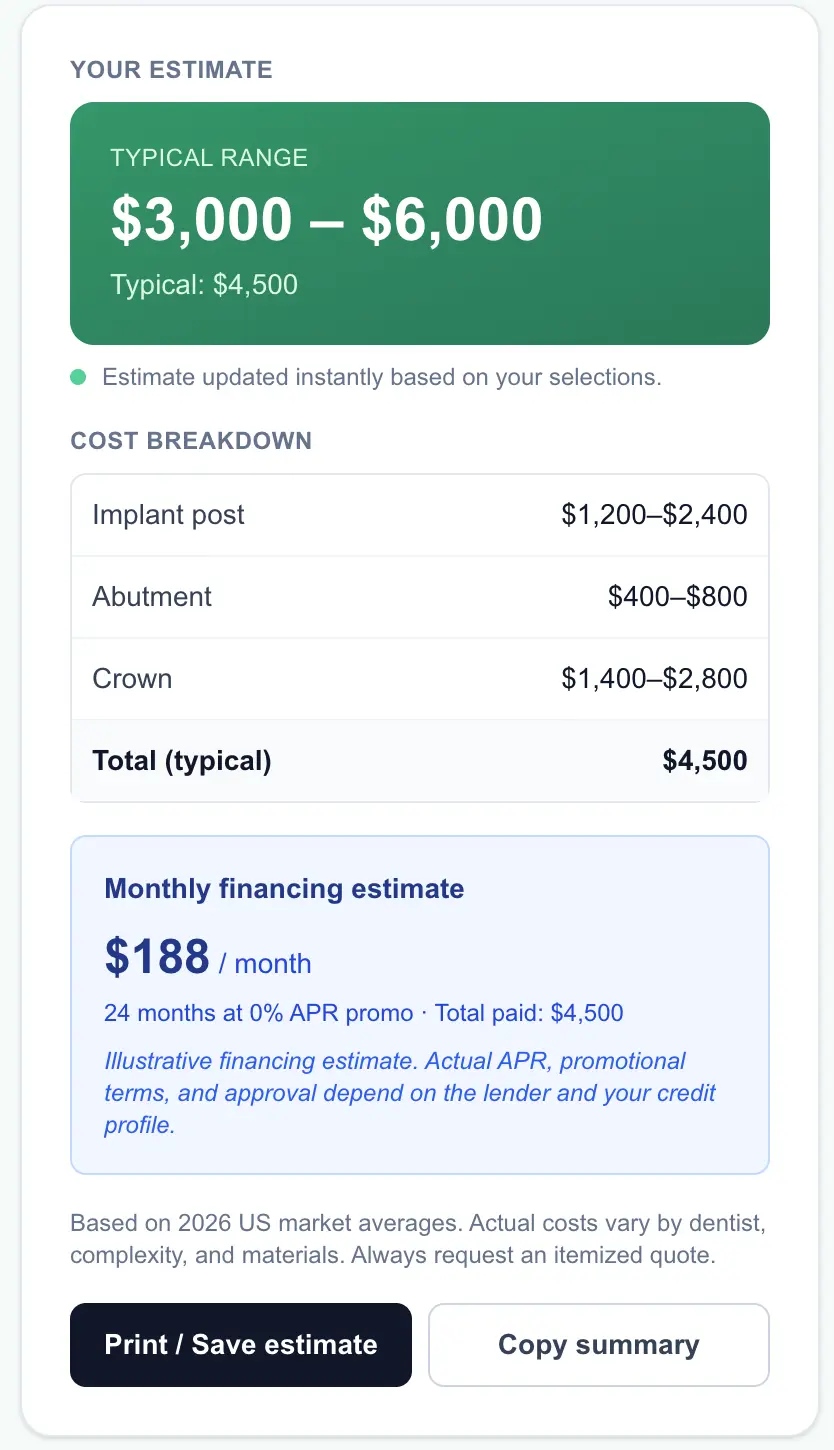
The results panel updates immediately whenever you change an option. Review the typical cost range, typical total, itemized cost breakdown, estimated insurance contribution, out-of-pocket amount, and optional monthly payment.

You can print the estimate, save it as a PDF through your browser's print window, or copy the summary.

Dental implant calculator results panel showing a real-time estimate

Procedure-specific options

The form changes for different treatments

Some treatments do not use the same options as a single-tooth implant. The calculator automatically shows only the fields that apply to your selected procedure.

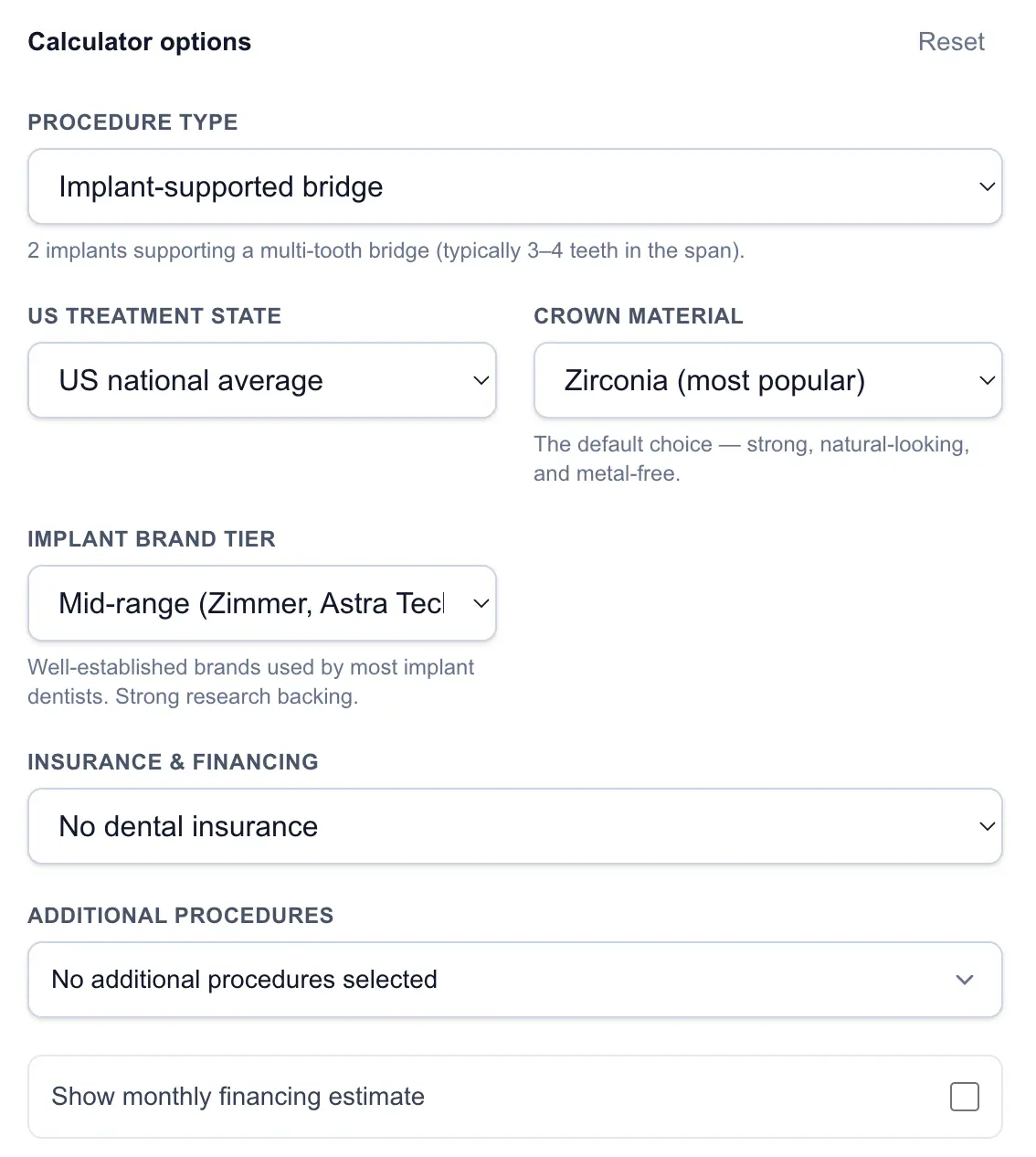
Implant-supported bridge

A bridge is priced as implants supporting multiple connected teeth, so the number-of-teeth field may not appear in the same way as it does for individual implants.

Calculator options for an implant-supported bridge

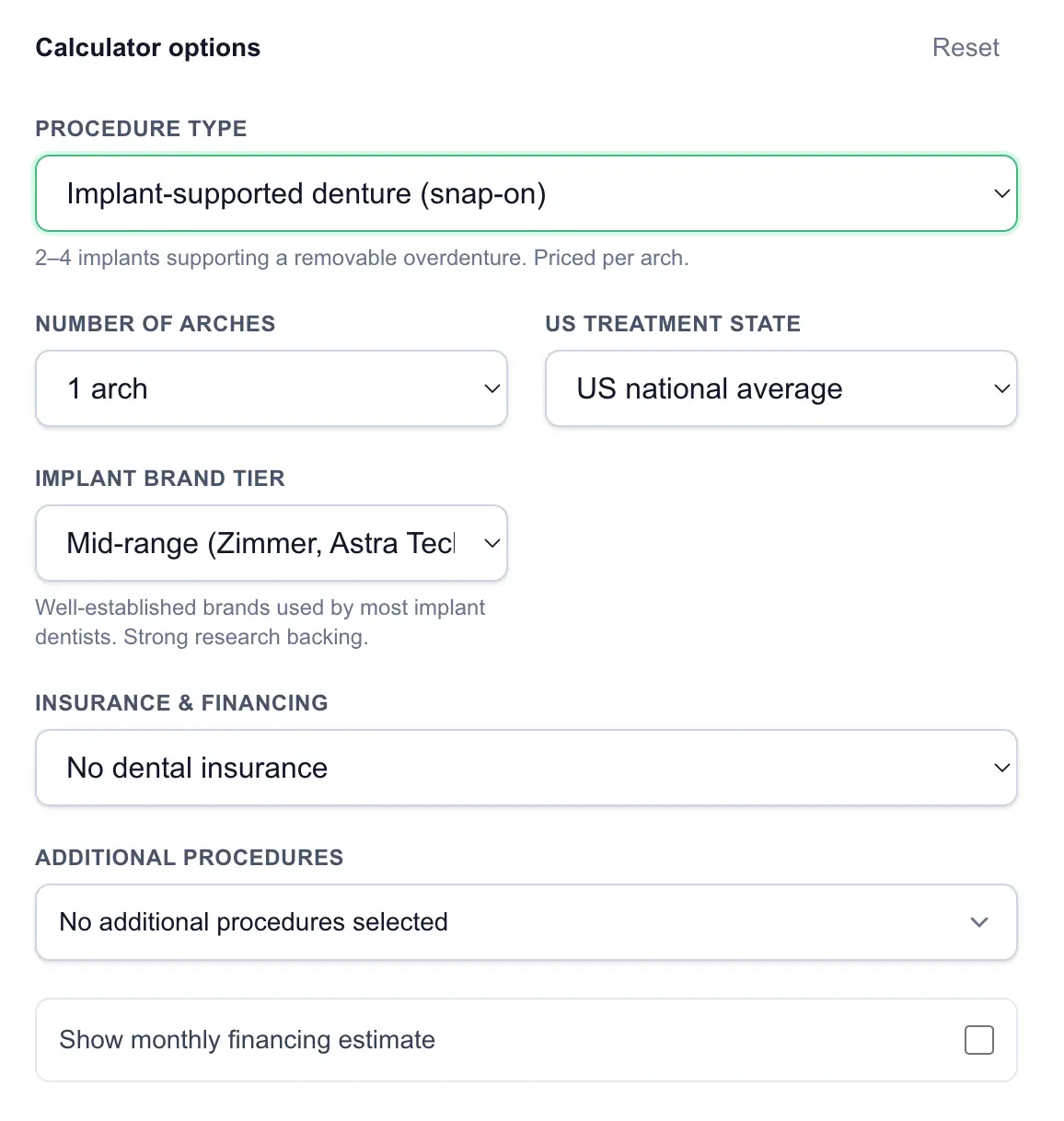
Implant-supported denture

A snap-on implant denture is priced per arch. The calculator therefore asks whether you need one arch or two arches instead of asking for a number of individual teeth.

Calculator options for an implant-supported snap-on denture

Start over

Use the Reset button to clear your selections

Select Reset at the top-right of the calculator whenever you want to remove your current choices and return the calculator to its original starting state. This is useful when you want to compare a different procedure or create a completely new estimate.

Important

The calculator provides an educational estimate based on market averages. It is not a diagnosis or a guaranteed dental quote. Request an itemized treatment plan from a licensed dentist before making a treatment decision.

2026 US pricing

How Much Do Dental Implants Cost in 2026?

A single dental implant in the US typically costs $3,000 to $6,000 all-in — that is, the implant post, the abutment that connects it to the crown, and the crown itself.

Full-arch and full-mouth restorations scale from there, but not linearly: multi-implant cases share fixed costs like surgery time and imaging, so the per-tooth price generally drops as the case gets larger.

Here is the 2026 US pricing range for the main implant procedures, all-in and before insurance:

ProcedureTypical US price range
Single tooth implant (post + abutment + crown)$3,000 – $6,000
Multiple single implants (2–4 teeth)$6,000 – $24,000
Implant-supported denture (per arch)$6,000 – $18,000
All-on-4 (per arch)$15,000 – $30,000
All-on-6 (per arch)$20,000 – $35,000
Full mouth (upper and lower, All-on-4)$30,000 – $60,000
Full mouth (upper and lower, All-on-6)$40,000 – $70,000

What can change the final price?

These figures assume standard materials, standard sedation, and no additional surgery. Some implant patients require additional procedures such as bone grafting, extraction or a sinus lift. And those add-ons can move the final number by several thousand dollars. The calculator above lets you toggle each one so the estimate reflects your actual case, not an ad-friendly minimum.

Understanding your estimate

What Affects the Cost of a Dental Implant?

No two implant cases cost the same, and the range is dramatic — a straightforward single tooth in a low-cost state runs about $3,000, while a full-mouth restoration on a complex case in a high-cost metro can pass $90,000. Six variables drive nearly all of that spread. Understanding each one lets you predict where your case will land — and where you have room to save.

Dental implant cost factors at a glance

Cost factorTypical cost impact
Procedure scopeBase ranges from $3,000 to $70,000
Your state16% below to 66% above the the national average
Add-on proceduresAdded separately when selected
Dentist's specialty and experience±15–30% for the same procedure
Implant brand tier−10%, 0% or +15% on applicable implant components
Crown material−15%, 0% or +15% on applicable crown components
1

Procedure scope: single tooth vs full arch

Cost impact: Determines the order of magnitude of your case — from $3,000 to $75,000+.

Replacing one tooth and replacing an entire arch are fundamentally different economic cases. A single implant carries the full cost of surgery time, imaging, lab work, and follow-ups for one crown. A full-arch case spreads those fixed costs across four, six, or more implants supporting a bridge — so the per-tooth cost drops sharply as the case scales up.

The practical upshot: if you're replacing 6 or more teeth in a row, All-on-4 or All-on-6 is almost always cheaper than placing that many individual implants. A per-tooth calculation on All-on-4 ($15,000–$30,000 per arch) works out to roughly $1,500–$3,000 per replaced tooth. Doing the same 10 teeth as individual implants would run $30,000–$60,000 — roughly double.

Something patients don't realize: for anything less than 4 replaced teeth in a row, individual implants remain cheaper than a full-arch prosthesis.

2

Your state

Cost impact: ±30–40% swing on the same procedure.

Dental prices track cost of living almost linearly. A single implant averages around $3,780 in Alabama and closer to $5,715 in California — a $2,000 spread on one tooth, and much larger on full-mouth cases. Coastal metros (New York, California, Massachusetts, DC) run 15–35% above the national average; most of the South and rural Midwest runs 5–15% below.

  • Lowest-cost states: Alabama, Oklahoma, Arkansas, Mississippi, Iowa
  • Highest-cost states: Hawaii, Massachusetts, California, Alaska, Maryland

For large cases (full-mouth, multiple full-arch), traveling to a lower-cost state is a legitimate strategy — some patients save $10,000 or more, which clears the trip cost several times over. For a single implant, the savings rarely justify the logistics.

3

Add-on procedures required

Cost impact: $0 to $10,000+ on top of the base implant fee, depending on case complexity.

This is where quotes surprise people most. The base implant fee usually doesn't include the procedures many patients need before the implant can be placed. Around half of all implant patients need at least one add-on. Here are the common ones, with real 2026 price ranges:

Tooth extraction

$150 to $650 per tooth; more if surgical

Bone graft

$300 to $1,200 per site; up to $5,000 for large ridge augmentations

Sinus lift

$1,500 to $5,000; common for upper back-jaw implants

CBCT (3D) scan

$250 to $600; most surgeons now require this for planning

IV sedation

$300 to $1,000 on top of local anesthesia

Temporary tooth

$300 to $1,000 to bridge the gap during healing

Ridge augmentation

$5,000 to $2,000 for larger bone volume rebuilding

The two biggest budget-breakers are bone grafting and sinus lifts, and they're strongly predictable: Bone changes can occur after tooth loss, but only an examination and appropriate imaging can determine whether grafting is needed. Ask your dentist directly during the consultation which add-ons your case will require, and get each one listed on the itemized quote — not buried in a lump-sum total.

4

Your dentist's specialty and experience

Cost impact: ±15–30% for the same procedure.

Dental implants are placed by four different kinds of clinicians: general dentists, oral surgeons, periodontists, and prosthodontists. A general dentist is usually the least expensive — sometimes 20–30% below a specialist for a comparable case. Specialists charge more, but for good reason: they've placed thousands of implants and handle complex cases (heavily grafted sites, immediate-load protocols, medically compromised patients) that a general dentist may not be equipped for.

Straightforward single implants in patients with healthy bone are within a well-trained general dentist's scope. Complex full-arch cases, sinus proximity, immediate-load protocols, and cases requiring extensive grafting belong with a specialist. Cheaper isn't a bargain if the case fails and has to be redone — implant failure rates for complex cases placed by inexperienced clinicians are meaningfully higher.

How to choose: ask your dentist directly how many implants they've placed in the past year, whether they routinely handle cases like yours, and whether they'd refer you out if the case turned out more complex than expected. A confident, honest answer is more valuable than the lowest quote.

5

Implant brand tier

Cost impact: +20–30% for premium vs value-tier brands.

The titanium post itself isn't a commodity. Premium systems from Straumann and Nobel Biocare cost 20–30% more than value-tier brands, and the difference isn't just marketing — the surface treatments, connection engineering, and decades of clinical data behind them are real. Straumann's SLActive surface, for example, has 20+ years of published data showing faster osseointegration than earlier generations.

That said, mainstream brands like Zimmer, BioHorizons, and Dentsply are backed by strong long-term data too, and are a reasonable default for most cases. Budget generic implants exist and can be significantly cheaper, but they carry two risks worth flagging: shorter clinical track records (some brands haven't been in the market long enough to have 10-year outcome data), and — more importantly — harder sourcing of replacement parts a decade later if any component ever needs replacement.

Practical guidance: for a straightforward single implant in a healthy patient, a value-tier brand from a reputable manufacturer is a reasonable choice. For a complex or high-visibility case, or if you're 40 or younger and want the implant to last several decades, the premium tier is often worth the added 20–30%.

6

Crown material

Cost impact: +15–25% for zirconia vs standard porcelain-fused-to-metal.

The visible tooth on top of the implant comes in four main options, each with real tradeoffs:

Acrylic

Cheapest, but only appropriate as a temporary or transitional crown. Not durable enough for long-term use.

Porcelain-fused-to-metal (PFM)

The traditional workhorse: strong, natural-looking, and priced accordingly. The main downside is the metal margin at the gumline can show as a dark line if the gums recede.

Zirconia

Increasingly the default for implant crowns. It holds up better under bite force than porcelain, has no metal margin to reveal, and is nearly indistinguishable from a natural tooth. Adds roughly 15–20% over PFM.

Layered zirconia or lithium disilicate

The premium tier used for high-aesthetic-zone cases (front teeth). Adds another 10–15% over standard zirconia.

For back teeth, PFM or zirconia is fine. For front teeth or high-visibility positions, zirconia or a layered ceramic is worth the upgrade — this crown is what you'll see in the mirror for the next 10–15 years.

Insurance and out-of-pocket costs

Dental Implant Cost With Insurance

Most dental insurance plans classify implants as a "major" procedure. In practice that means:

Coverage percentage

Typically 50%

Applied after your deductible.

Annual maximum

Typically $1,000 to $2,000

This limits how much the plan will pay during the benefit year.

Waiting period

Often 6 to 12 months

Many plans impose a 6- to 12-month wait before major work is covered.

Missing tooth clause

Pre-existing gaps may be excluded

Some plans won't cover replacement of a tooth that was already missing before you enrolled.

How dental implant insurance is calculated

Here is the calculation order the calculator uses — and the order your insurer actually uses:

  1. 1

    Start with the treatment cost

  2. 2

    Subtract the deductible you haven't yet met this year

  3. 3

    Multiply the remainder by your coverage percentage

  4. 4

    Cap the result at your remaining annual maximum

  5. 5

    Whatever's left after that is your out-of-pocket cost

A worked insurance example

A worked example: a $5,000 single implant, on a plan with a $50 deductible, 50% coverage on major work, and a $1,500 annual maximum.

Insurance calculation

($5,000 − $50) × 50% = $2,475

Capped at the $1,500 annual maximum

Insurance pays

$1,500

You pay

$3,500

The math is ($5,000 − $50) × 50% = $2,475, capped at $1,500. Insurance pays $1,500. You pay $3,500. The annual maximum is doing the heavy lifting here, not the coverage percentage — and that's true for almost every implant case.

Two things about implant coverage that surprise people:

1

The implant post may not be covered

Many plans cover only the crown and abutment, and exclude the surgical placement of the post itself. Read the "major services" section of your plan booklet — if implants are only mentioned under "prosthetics," the surgical post may not be covered at all.

2

Timing treatment can affect your benefits

The annual maximum resets on either the calendar year or your plan year. If you're doing a large case, splitting it across two benefit years can effectively double what insurance contributes. December placement, January restoration, for example.

Cash-pay dental implant costs

Dental Implant Cost Without Insurance

If you're paying cash, a single implant runs the full $3,000 to $6,000 all-in, and larger cases scale up from there. The good news: cash-pay patients often have more leverage than insured patients realize, because the dentist saves the administrative overhead of dealing with an insurer.

Practical ways to reduce a cash-pay implant bill:

1

Ask for the cash discount.

Many practices offer 5–10% off if you pay upfront rather than financing. It's rarely advertised — you have to ask.

2

Get three itemized quotes.

Prices for the identical procedure vary widely within the same zip code. An itemized quote (post, abutment, crown, imaging, surgery, sedation, follow-ups listed separately) lets you compare apples to apples.

3

Use HSA or FSA dollars.

Dental implants qualify as a medical expense under IRS Publication 502. Paying with pre-tax dollars from an HSA or FSA effectively discounts the price by your marginal tax rate — often 22–32%, which is a bigger discount than most cash offers.

4

Consider dental schools.

University dental schools with residency programs place implants at significantly reduced fees. The trade-off is a slower timeline (residents work more slowly, and every step is supervised by faculty), but the clinical quality is generally excellent because of that same supervision.

5

Look at CareCredit and LendingClub.

Both offer dental-specific financing with promotional 0% APR periods (usually 6, 12, 18, or 24 months). If you can pay off the balance within the promo period, the effective interest cost is zero. If you can't, the rate that kicks in retroactively is high, so run the numbers first.

6

Cross-border options.

Mexico (Los Algodones, Tijuana, Cancún) and Costa Rica are established dental tourism markets with implant costs 50–70% below US prices. This can be a good option for full-mouth cases where the savings clear the travel cost several times over, but it puts follow-up care and warranty resolution offshore — which matters more than most patients think until something goes wrong.

Common questions

Dental Implant Cost — Frequently Asked Questions

1. Why does my dentist's quote look higher than the calculator estimated?

Usually one of three reasons: add-ons (bone graft, sedation, extraction) that weren't checked on the calculator, a specialist rather than a general dentist (15–30% more), or a premium implant brand like Straumann or Nobel Biocare (20–30% more on the post fee). Re-run the calculator with those adjusted — the gap usually closes. If it doesn't, get a second opinion. Prices for the same case vary widely within the same city.

2. Should I get a dental implant, a bridge, or dentures?

For a single missing tooth with healthy neighbors, an implant is usually the best long-term choice — it preserves the jawbone and doesn't damage adjacent teeth. A bridge is faster and cheaper up front but lasts 10–15 years. Dentures are the most affordable full-arch option but reduce chewing efficiency. Rough rule: implants win on comfort and long-term cost; bridges and dentures win on speed and upfront price.

3. How long does the entire dental implant process take?

For a straightforward single implant with no add-ons, 3 to 6 months from consultation to final crown. Most of that is healing time — actual chair time is under 3 hours total. Cases needing a bone graft or sinus lift add 3–6 months on the front end for the graft to heal before the implant can be placed.

4. How painful is getting a dental implant?

Less than most people expect. The surgery is done under local anesthesia (often with IV sedation), so the procedure itself is painless. Days 1–3 afterward involve mild-to-moderate soreness, similar to a tooth extraction, usually managed with ibuprofen. Most patients return to normal activity within 2–3 days. Root canals and wisdom tooth removals are typically reported as more uncomfortable.

5. Are dental implants cheaper in Mexico or overseas?

Yes, significantly. A single implant runs $900–$2,000 in Mexico, $1,000–$2,500 in Costa Rica, and $500–$1,500 in Turkey — vs $3,000–$6,000 in the US. The math favors overseas care for large cases where the savings clear the trip cost several times over. Tradeoff: if something fails two years later, resolving it means another trip, and many US dentists won't service implants they didn't place.

6. What happens if my dental implant fails? Do I have to pay for a new one?

Depends on the dentist's warranty and how long it's been. Most reputable practices replace a failed implant at no cost within the first 12 months. After 5 years, replacement is usually the patient's cost — though some premium brands offer 10+ year manufacturer warranties on the fixture itself. Ask the dentist about their warranty policy before you commit, and get it in writing.

7. Why do many insurance plans not cover the implant post itself?

Historically, dental plans classified implants as experimental or cosmetic, and the legacy exclusions carried forward. Many plans today cover only the crown and abutment, and exclude the surgical placement of the post because it's considered a surgical (not restorative) procedure. Always request a pre-authorization from your insurer before committing — it locks the coverage decision in writing.

8. Can I finance dental implants if I can't pay upfront?

Yes, most patients do. The main options are in-house dentist payment plans (often 0% over 6–12 months, but you have to ask), CareCredit and similar dental-specific financing with 0% promotional periods, and HSA/FSA dollars — which effectively discount the price by your marginal tax rate (22–32% for most working adults) and are often the single most impactful move.